Lap Band Surgery Or A 500 Calorie Diet?
If you are contemplating lap band surgery then you might well be encouraged by the results of an Australian study which reported that, in a controlled test, lap band surgery proved to be far more effective in the long term than a very restrictive 500 calorie diet. However, before you rush off to your surgeon, you might just like to take a moment to examine the study closely.
The study involved a total of 80 patients half of whom were given lap band surgery and half of whom were put on a very low calorie diet of just 500 calories.
After six months both groups were showing similar results and had lost about fourteen percent of their starting weight. However, at the end of two years the results for the two groups looked very different.
The lap band surgery patients had lost about twenty two percent of their starting weight and showed a marked improvement in their health and quality of life. By contrast, the dieting group had re-gained much of the weight they lost in the first few months of their diet and, on average, were only just over five percent below their starting weight.
This result would seem to confirm what many people, including most doctors, already know and this is that dieting, other than to lose the odd pound or two now and again, really doesn't work. It would also appear to make a strong case for gastric banding.
Lap band surgery is one of several options open to patients as a solution to the problem of morbid obesity and is generally only considered once a patient's BMI reaches 40. Exceptions can be made and lap banding offered to patients with a BMI as low as 35, but this is normally only done when the patient is also suffering from a potentially life threatening medical condition which is linked to being overweight. For the majority of patients this means that lap band surgery would normally be considered at the point at which they are about 100 pounds overweight.
In the case of this study however the patients chosen for the study were just 50 pounds overweight. So, can we really rely on these results when this is not the target group to which lap band surgery would normally be applied?
The truth of the matter is of course that lap band surgery can be very effective in cases of morbid obesity and is proving to be a very popular choice with many patients. As with all forms of obesity treatment however it is vitally important that we collect sound data so that the various different methods can be evaluated and patients given accurate advice on which they can base their treatment decisions.
Studies of this nature certainly do not add to the base of knowledge which we need to be building and have more to do with grant funding from a lap band manufacturer than they do with any desire to advance the treatment of obesity.
Of course that is only the writer's view and you may well disagree.
GastricBypassFacts.info is a substantial resource center providing information on all aspects of gastric bypass surgery and includes a number of articles covering such things as lap band surgery.
Aug 16, 2008
Lap Band Surgery Or A 500 Calorie Diet?

Aug 7, 2008
Lap Band Surgery To Cure Morbid Obesity
Lap Band Surgery To Cure Morbid Obesity
Although the term lap band is commonly used today when talking 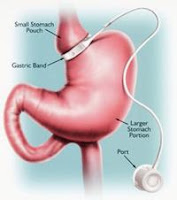 about gastric banding surgery, LAP-BAND® is in fact the registered trade-mark for just one form of gastric band developed by an American company and approved in 2001 by the FDA for use in the United States.
Gastric banding, which is a type of purely restrictive weight loss surgery (that is to say that it works solely by restricting the quantity of food which can be consumed), includes both vertical banded gastroplasty and adjustable gastric banding. In the case of lap band surgery we are looking only at adjustable gastric banding.
The lap band system comprised a silicone ring with an inflatable inner lining which is designed to be placed around the upper section of the stomach. The band is then connected by a length of tubing to an access port which is placed just below the surface of the skin during surgery.
The placement of the band high up on the stomach creates a small pouch at the top of the stomach to hold food, with the bulk of the stomach now being below the band. The placement of the band also creates a very small opening, or stoma, between the two sections of the stomach and the size of this opening can be controlled by introducing liquid (normally saline) into, or removing liquid from, the inflatable inner ring of the band through the access port.
During lap band surgery the inner band is normally only given a very minimal inflation producing a relatively large opening between the two sections of stomach. Although the term relative is used here it should be noted that the newly created small stomach pouch and the opening between the sections of the stomach are in reality both very small.
In the period immediately following lap band surgery, the inner ring will be gradually inflated until a point is reached at which weight loss is optimized and the patient is comfortable with the size and frequency of meals that he/she can eat.
Restrictive forms of weight loss surgery are generally easier to perform than other procedures and lap band surgery is often performed laparoscopically which results in a reasonably short stay in hospital and a fairly fast post-operative recovery. This type of surgery also avoids many of the nutritional problems seen in malabsorption surgery (gastric bypass surgery in which food is re-routed through part of the small intestine). Finally, lap band surgery is totally reversible and removal of the band will result in the stomach returning to its normal size.
For more information on lap band surgery please visit Gastric Bypass Facts today.
Nov 14, 2007
Lap Band Success Rate
Lap band weight loss surgery has been performed internationally since its introduction in the mid 1990s and, in many countries, it has now become very much the preferred method of weight loss surgery. It was not however licensed for use in the United States until June 2001 and it is only now that sufficient statistics are becoming available to allow us to assess just how good a treatment it is for those seeking a solution to morbid obesity.
At this early stage the lap band success rate is looking pretty good, which is excellent news for the 15 million Americans who are now classed as being severely obese. Weight loss achieved using lap band surgery compares favorably with other forms of surgery and there are also fewer complications, both during and after surgery, with those complications that do occur proving less serious than in other forms of weight loss surgery. Lap band success is also being seen in the terms of the reduction of associated (co-morbid) conditions such as type 2 diabetes, sleep apnea and hypertension.
On average patients are spending less time in hospital with an overnight stay for lap band surgery compared to a stay of 2 to 3 days for laparoscopic Roux-en-Y surgery and 3 to 4 days for the open Roux-en-Y procedure. In addition, recovery time is much improved with lap band patients resuming their normal activities within about a week compared to 2 to 3 weeks for Roux-en-Y patients.
As a purely restrictive form of surgery, early post-operative weight loss for lap band patients is less dramatic than that seen in open or laparoscopic Roux-en-Y patients but is nonetheless still impressive with patients achieving similar weight loss in the longer term.
In one early study involving 271 US patients undergoing lap band surgery the average weight loss achieved 3 years after surgery was 47% of excess body weight, while a second US study of 63 patients showed an excess weight loss of 53%. Several studies involving larger groups of patients from both Italy and Australia over a similar 3 year period show excess weigh loss ranging from 49% to as high as 68%.
In most cases of weight loss surgery attention tends to be focused on weight loss when assessing just how successful a procedure is and it is easy to think that an operation which produces a 50% weight loss must be more successful than one that produces a 45% weight loss. In reality of course both can be equally successful as the true question is whether or not patients lose sufficient weight to meet their expectations and see an overall improvement in their general health, life expectancy and quality of life. Lap band success therefore needs to be measured in terms of the overall package of benefits that it delivers to its patients.
Of all the surgical options available today lap band surgery is the least invasive and involves the shortest period of hospitalization and fastest recovery. It is also the only adjustable form of surgery currently available and is the easiest form of surgery to reverse. Perhaps most importantly, it avoids many of the problems associated with stomach stapling and re-routing of the intestinal tract which makes it very much safer than other forms of weight loss surgery.
It is still early days of course and time will tell but, if early lap band success is anything to go by, it would seem safe to say that lap band weight loss surgery is set to follow the pattern seen internationally and it may well soon become the preferred option in the United States.
For further information about lap band success please visit Gastric Bypass Facts today.
