Lap Band Surgery Or A 500 Calorie Diet?
If you are contemplating lap band surgery then you might well be encouraged by the results of an Australian study which reported that, in a controlled test, lap band surgery proved to be far more effective in the long term than a very restrictive 500 calorie diet. However, before you rush off to your surgeon, you might just like to take a moment to examine the study closely.
The study involved a total of 80 patients half of whom were given lap band surgery and half of whom were put on a very low calorie diet of just 500 calories.
After six months both groups were showing similar results and had lost about fourteen percent of their starting weight. However, at the end of two years the results for the two groups looked very different.
The lap band surgery patients had lost about twenty two percent of their starting weight and showed a marked improvement in their health and quality of life. By contrast, the dieting group had re-gained much of the weight they lost in the first few months of their diet and, on average, were only just over five percent below their starting weight.
This result would seem to confirm what many people, including most doctors, already know and this is that dieting, other than to lose the odd pound or two now and again, really doesn't work. It would also appear to make a strong case for gastric banding.
Lap band surgery is one of several options open to patients as a solution to the problem of morbid obesity and is generally only considered once a patient's BMI reaches 40. Exceptions can be made and lap banding offered to patients with a BMI as low as 35, but this is normally only done when the patient is also suffering from a potentially life threatening medical condition which is linked to being overweight. For the majority of patients this means that lap band surgery would normally be considered at the point at which they are about 100 pounds overweight.
In the case of this study however the patients chosen for the study were just 50 pounds overweight. So, can we really rely on these results when this is not the target group to which lap band surgery would normally be applied?
The truth of the matter is of course that lap band surgery can be very effective in cases of morbid obesity and is proving to be a very popular choice with many patients. As with all forms of obesity treatment however it is vitally important that we collect sound data so that the various different methods can be evaluated and patients given accurate advice on which they can base their treatment decisions.
Studies of this nature certainly do not add to the base of knowledge which we need to be building and have more to do with grant funding from a lap band manufacturer than they do with any desire to advance the treatment of obesity.
Of course that is only the writer's view and you may well disagree.
GastricBypassFacts.info is a substantial resource center providing information on all aspects of gastric bypass surgery and includes a number of articles covering such things as lap band surgery.
Aug 16, 2008
Lap Band Surgery Or A 500 Calorie Diet?

Aug 7, 2008
Lap Band Surgery To Cure Morbid Obesity
Lap Band Surgery To Cure Morbid Obesity
Although the term lap band is commonly used today when talking 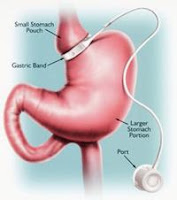 about gastric banding surgery, LAP-BAND® is in fact the registered trade-mark for just one form of gastric band developed by an American company and approved in 2001 by the FDA for use in the United States.
Gastric banding, which is a type of purely restrictive weight loss surgery (that is to say that it works solely by restricting the quantity of food which can be consumed), includes both vertical banded gastroplasty and adjustable gastric banding. In the case of lap band surgery we are looking only at adjustable gastric banding.
The lap band system comprised a silicone ring with an inflatable inner lining which is designed to be placed around the upper section of the stomach. The band is then connected by a length of tubing to an access port which is placed just below the surface of the skin during surgery.
The placement of the band high up on the stomach creates a small pouch at the top of the stomach to hold food, with the bulk of the stomach now being below the band. The placement of the band also creates a very small opening, or stoma, between the two sections of the stomach and the size of this opening can be controlled by introducing liquid (normally saline) into, or removing liquid from, the inflatable inner ring of the band through the access port.
During lap band surgery the inner band is normally only given a very minimal inflation producing a relatively large opening between the two sections of stomach. Although the term relative is used here it should be noted that the newly created small stomach pouch and the opening between the sections of the stomach are in reality both very small.
In the period immediately following lap band surgery, the inner ring will be gradually inflated until a point is reached at which weight loss is optimized and the patient is comfortable with the size and frequency of meals that he/she can eat.
Restrictive forms of weight loss surgery are generally easier to perform than other procedures and lap band surgery is often performed laparoscopically which results in a reasonably short stay in hospital and a fairly fast post-operative recovery. This type of surgery also avoids many of the nutritional problems seen in malabsorption surgery (gastric bypass surgery in which food is re-routed through part of the small intestine). Finally, lap band surgery is totally reversible and removal of the band will result in the stomach returning to its normal size.
For more information on lap band surgery please visit Gastric Bypass Facts today.
